
Horse racing is one of the few sports where the same bet can be quoted three different ways depending on where you read it. A British racecard shows 5/2. A European exchange shows 3.50. An American sportsbook shows +250. They all mean exactly the same thing — but unless you do the math in your head, you cannot tell at a glance whether the price you are about to take is better, worse, or identical to the one you saw five minutes ago on a different screen.
The horse.bet odds converter turns that friction into a non-issue. Type any odds in any field — fractional, decimal, American, or implied probability — and the other three update instantly. You can finally compare a Bet365 price quoted in fractional with a Pinnacle line quoted in American without leaving the tab.
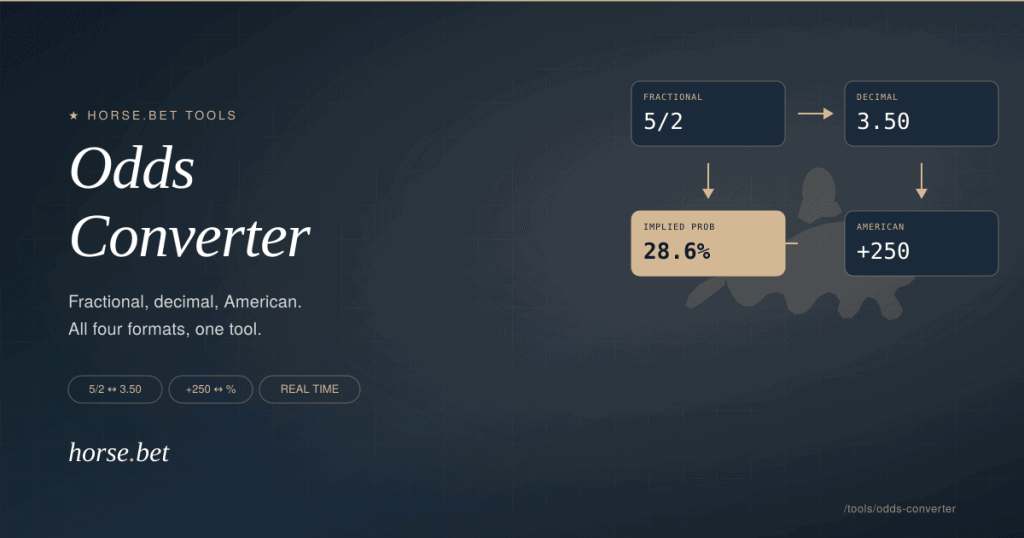
The implied-probability field is the one most punters never think to look at, and the one that quietly matters most. It tells you what the bookmaker thinks the chance of the outcome is — before their margin is added in. Once you start reading odds as probabilities, betting starts to look less like a number game and more like a question of whether you agree with the market.
Odds converter
Convert between fractional, decimal and American (moneyline) odds, with implied probability. Edit any field and the others update instantly.
5/2, 11/4, evensCommon odds reference table
| Fractional | Decimal | American | Implied % |
|---|
Bookmaker margins built into displayed odds mean implied probabilities total over 100% on a single race. The “true” probability is lower than what odds suggest. 21+ where applicable · 1-800-GAMBLER · GambleAware.org
How to use Betting Odds Converter
There is nothing to set up. Click into any one of the four fields, type a value, and the other three populate themselves.
- Fractional — the format used by British and Irish bookmakers and racecards. Type
5/2,11/4, orevens. The hyphen also works (5-2). - Decimal — the format used by European bookmakers, betting exchanges, and most calculators. Type
3.50. The decimal includes your stake, so 2.00 is even money. - American (moneyline) — the format used by US sportsbooks. Positive numbers like
+250are underdogs and tell you the profit on a $100 stake. Negative numbers like-150are favorites and tell you the stake needed to win $100. - Implied probability — what the displayed odds say about the chance of the outcome. Type
28.6%, for instance, and the converter will give you the odds that mathematically correspond.
Below the four input fields, a one-line summary translates the conversion into plain language: how much a £10 stake returns, the profit on the stake, and a brief description of the price (odds-on favorite, mid-market chance, longshot, etc).
If you want a reference for the most common bookmaker prices, expand the table at the bottom — thirty quotations from 1/4 to 100/1 with the decimal, American and implied-percentage equivalents next to each.

Best practice
- Get comfortable reading prices as probabilities. 5/2 means “the bookmaker thinks this has a 28.6% chance of winning, before margin”. Once that flips in your head, odds stop being abstract numbers and start being claims you can agree or disagree with.
- Watch for the gap between displayed probability and true probability. Bookmakers build a margin into every market. If you add up the implied probabilities of every runner in a race, you will get more than 100% — usually 110% to 125%. That excess is the bookmaker’s edge.
- Use the converter to compare prices across formats. If a US sportsbook offers a horse at +280 and a UK firm at 9/4, which is the better price? +280 = decimal 3.80 = fractional 14/5. 9/4 = decimal 3.25. The US price is meaningfully better — about 17% more profit per unit staked.
- Don’t round mentally. The difference between 11/4 (3.75) and 3/1 (4.00) is small in fractional but 6.7% better in real returns. Over a year of betting, this is the difference between profit and loss.
Using Odds Converter
Example 1 — A short-priced favorite
Input: 4/6 (fractional)
- Decimal: 1.67
- American: −150
- Implied probability: 60.0%
A £10 stake returns £16.67. The bookmaker is implying a 60% chance of victory — an odds-on favorite. To break even over time, this runner needs to win at least 60% of the time at this price, which is a high bar against the bookmaker’s built-in margin.
Example 2 — The classic each-way price
Input: 5/2 (fractional)
- Decimal: 3.50
- American: +250
- Implied probability: 28.6%
A £10 stake returns £35.00. The market sees this as roughly a 1-in-3-and-a-half chance. In a competitive eight-runner handicap with a 120% market, this is a fair price for a sound favorite.
Example 3 — Finding the value horse
Input: 16/1 (fractional)
- Decimal: 17.00
- American: +1600
- Implied probability: 5.9%
The bookmaker is saying this horse has a 5.9% chance — about 1 in 17. If your reading of the race suggests its true chance is closer to 10%, you have an edge. That is value betting in a nutshell.
Example 4 — Working back from a probability
Input: 25% (implied probability)
- Decimal: 4.00
- Fractional: 3/1
- American: +300
If your analysis says a horse has a 25% chance to win, the fair odds are 3/1. Anything longer than 3/1 is value. Anything shorter is the bookmaker’s overround working against you.
Methodology — how the conversions work
The four formats are all expressing the same underlying number — the ratio of return to stake. The converter holds decimal odds as the canonical form internally and translates in and out of the other three on the fly.
Fractional ↔ decimal
To decimal: fractional_numerator ÷ fractional_denominator + 1. So 5/2 = (5 ÷ 2) + 1 = 3.50.
To fractional: the inverse, with a snap to the nearest standard bookmaker fraction. Decimal 1.91 maps to 10/11 (the standard price), not 91/100 (the literal conversion). Our converter looks up the nearest entry in the standard bookmaker price ladder — 1/5, 2/9, 1/4, 2/7, 3/10, 1/3, 2/5, 4/9, 1/2, 4/7, 8/13, 4/6, 4/5, 5/6, 10/11, evens, 11/10, 6/5, 5/4, 11/8, 6/4, 13/8, 7/4, 15/8, 2/1, 9/4, 5/2, 11/4, 3/1, 10/3, 7/2, 4/1, 9/2, 5/1, 11/2, 6/1, 13/2, 7/1, 15/2, 8/1, and so on up to 1000/1.
Decimal ↔ American
From decimal to American: if decimal ≥ 2.00, American = (decimal − 1) × 100, shown with a +. If decimal < 2.00, American = −100 ÷ (decimal − 1), shown with a −.
From American: positive values give 1 + n / 100. Negative values give 1 + 100 / |n|.
Decimal ↔ implied probability
Implied probability is simply the inverse of decimal odds, expressed as a percentage: (1 ÷ decimal) × 100. So decimal 4.00 = 25%, decimal 2.00 = 50%, decimal 1.50 = 66.7%.
What “implied” really means
The implied probability is what the displayed odds claim about the outcome. It is not the bookmaker’s honest assessment — that figure would be slightly lower, because every bookmaker builds in a margin (the “overround” or “vig”) to guarantee a long-run profit. In a typical eight-runner handicap, the sum of implied probabilities across the field is around 115% to 120%. The 15–20% excess is the bookmaker’s edge.
If you want the bookmaker’s “true” probability for a horse, you need to strip out that overround. Our UK predictor does it automatically for live races.
Frequently asked questions
Why are American odds quoted with + and −?
The +/− tells you whether the bet is on a favorite or an underdog. Positive numbers represent underdogs and quote the profit on a $100 stake (so +250 means $250 profit). Negative numbers represent favorites and quote the stake needed to win $100 (so −150 means stake $150 to win $100). The system is intuitive once you get used to it but unintuitive to anyone arriving from fractional or decimal.
Are decimal odds and exchange odds the same?
Almost. Betting exchanges (like Betfair) display in decimal but use slightly different terminology — they call decimal odds “back odds” and quote “lay odds” separately for those wanting to bet against an outcome. The mathematics is identical; the application is different.
What format do most professional bettors use?
Decimal, by a wide margin. It is the cleanest for arithmetic, removes the +/− ambiguity of American, and avoids the snap-to-fraction quirks of British prices. Most betting software, exchanges, and modelling tools use decimal as the working format.
Can you bet at an implied probability of 100% or higher?
No — that would mean odds of 1.00 or below, where you receive less than (or equal to) your stake even on a winning bet. Bookmakers never offer such prices. Implied probabilities above 100% would only ever appear when summing across multiple outcomes in a single market — which is what creates the overround.
Visit our Racing Data center to find odds, stats, and more: click for UK data and for U.S. races.
More free betting tools
21+ Please gamble responsibly. Gambling problem? Call 1-800-GAMBLER (in New York, 1-877-8-HOPENY or text 467369). Online horse racing wagering is legal only in some states; check where you live before you bet.